R: Let’s take this one, here’s its number. See? It’s all there. And this one was shot down literally about a year ago.

I: Is it made of cardboard or what?
R: Yeah, sorry, as we say, it’s made of shit and sticks, no other way to put it. That’s just how it is. But it’s not cardboard, it’s plastic fiberglass, something like that.
R: These are the ones Iran gave them [russians] in 2022. Well, ’23 actually – there weren’t any in ’22.
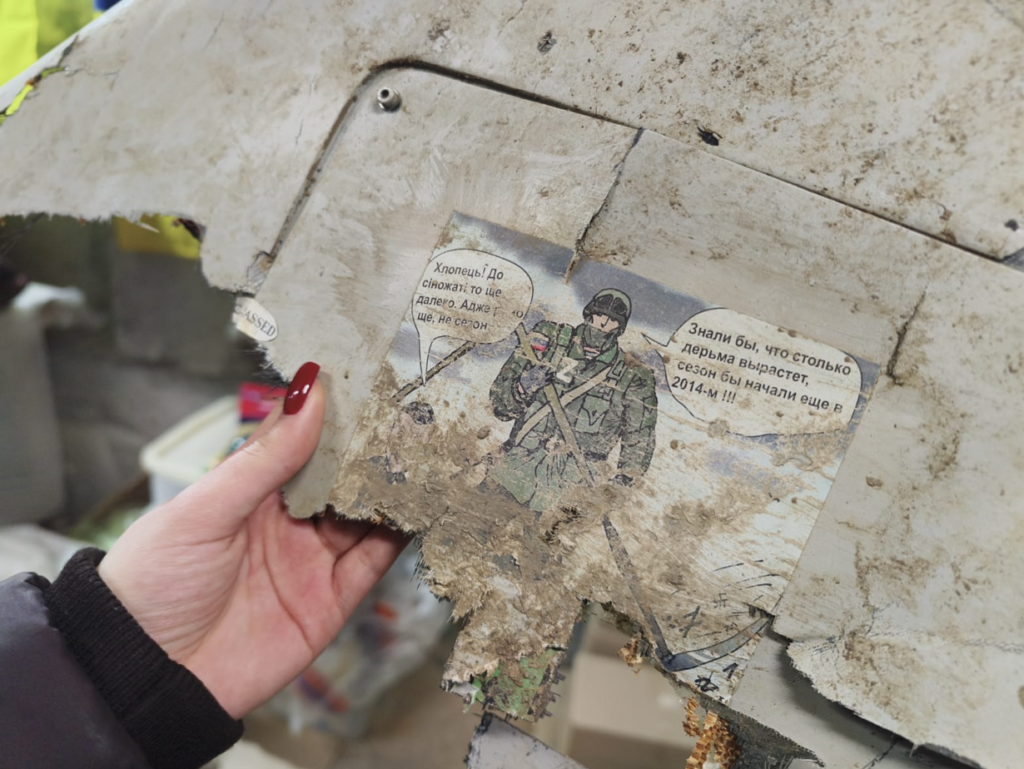
And this is when they started producing them. [knocks on the back of the drone] See? It’s plastic.
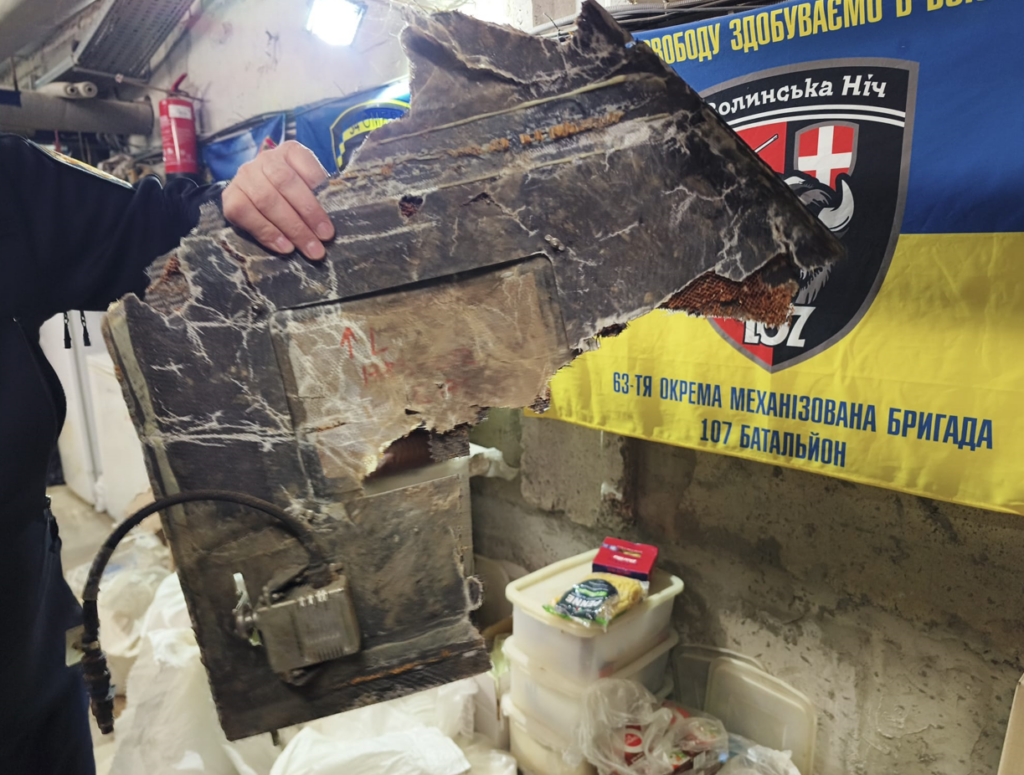
R: That’s its official number.
I: “Ы”? Couldn’t they come up with anything better?
R: These are very interesting exhibits. I also had a motor from one of them, but I gave it away, like most things.

V: [in English] Ghost of Kharkiv? [Points at a patch]
R: Yeah, Ghosts of Kharkiv. It’s not a specific unit, it’s a general name. People started talking about the Ghosts of Kharkiv in ’22 when they started shooting down planes over Kharkiv. It’s an air defense unit.
R: Yeah, air defence. It all started at the academy – we have an air force academy that used to be called [Redacted], on [Redacted]. It started there. I know the commander. They were strictly officers. They were delivering bread in civilian cars. They had MANPADS, Stingers, and all that. They gave me this patch [on the right in image].
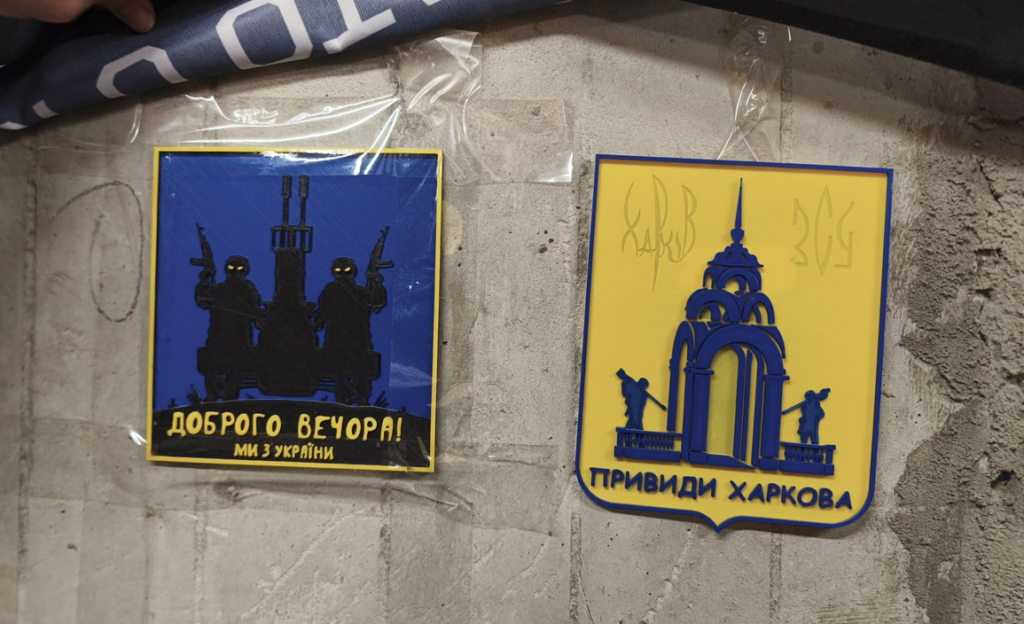
R: This is also 3D-printed [on the left in image].
V: [reads Ukrainian inscription] Good evening, we are from Ukraine.
R: That’s our Kharkiv steel right there.
V: Cool. Very interesting.
R: Something like that.
I: And what’s this painting? [Points at a painting showing a russian orc (soldier) in a wheat field].
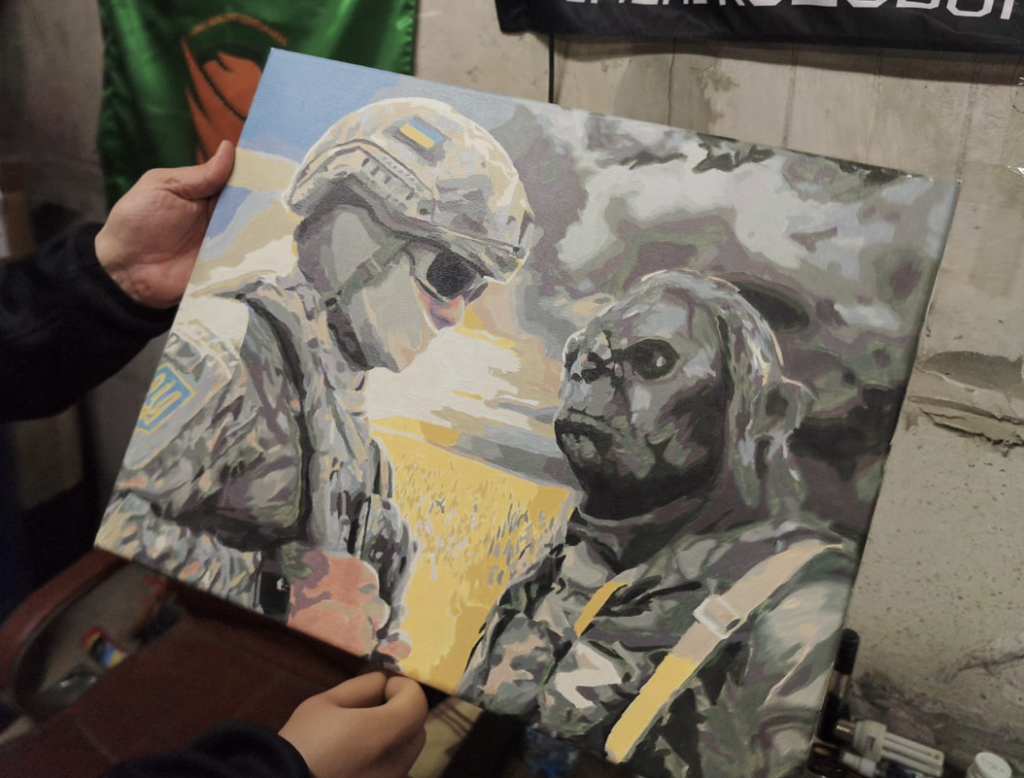
R: Someone gave this to me. Everyone asks about it because it’s cool. This is the road to Donbas that goes through Kharkiv. The guys were heading to a special unit and gave it to me. I’ve known them for a long time, since they were cadets in ’22. Can’t say anything more to you, unfortunately. They were already on their way to work in the special unit. That top flag right there – you’ll understand who that is.
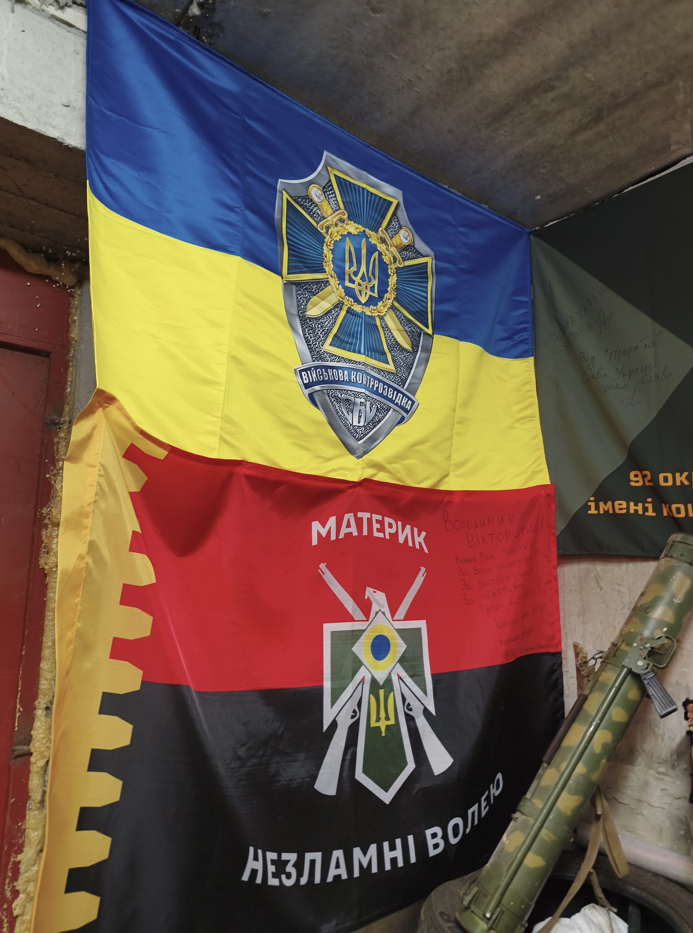
I: The top flag, the green one?
R: No, no, the yellow and blue one. Read it and you’ll get who it is.
I: Military Intelligence. [Interpreting to English].
R: They just dropped it off for me as a memento, just gave it to me like that.
V: [Going back to painting] So this is a Russian orc?
R: Yeah, yeah. It’s a gift. Basically, every flag is a whole story. I remember everything. Absolutely everything. This, by the way, is a recent gift. It’s a Russian fiber-optic drone. See the fiber optics?
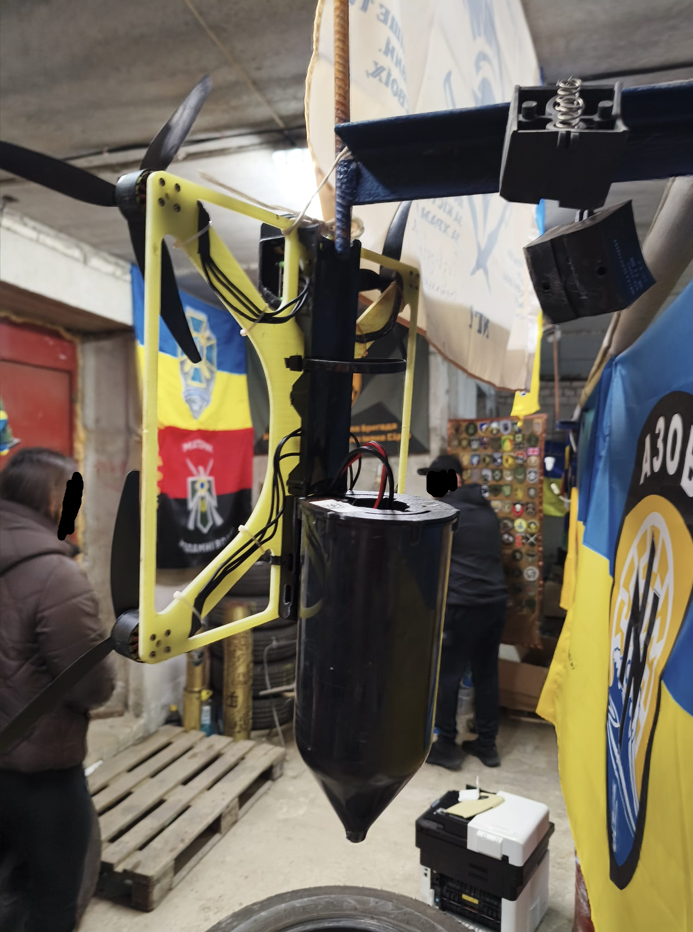
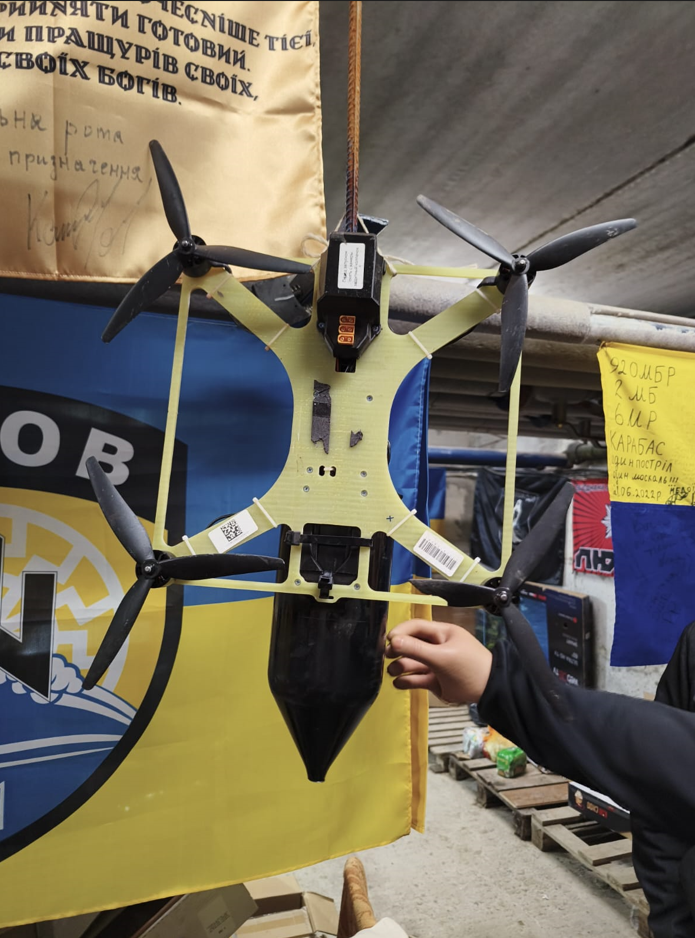
V: Oh, wow! Is that the one that goes for 30km—
R: [in Ukrainian] It has a range of 30 kilometers. It just lands… Yeah, yeah, you can touch it, it’s safe.
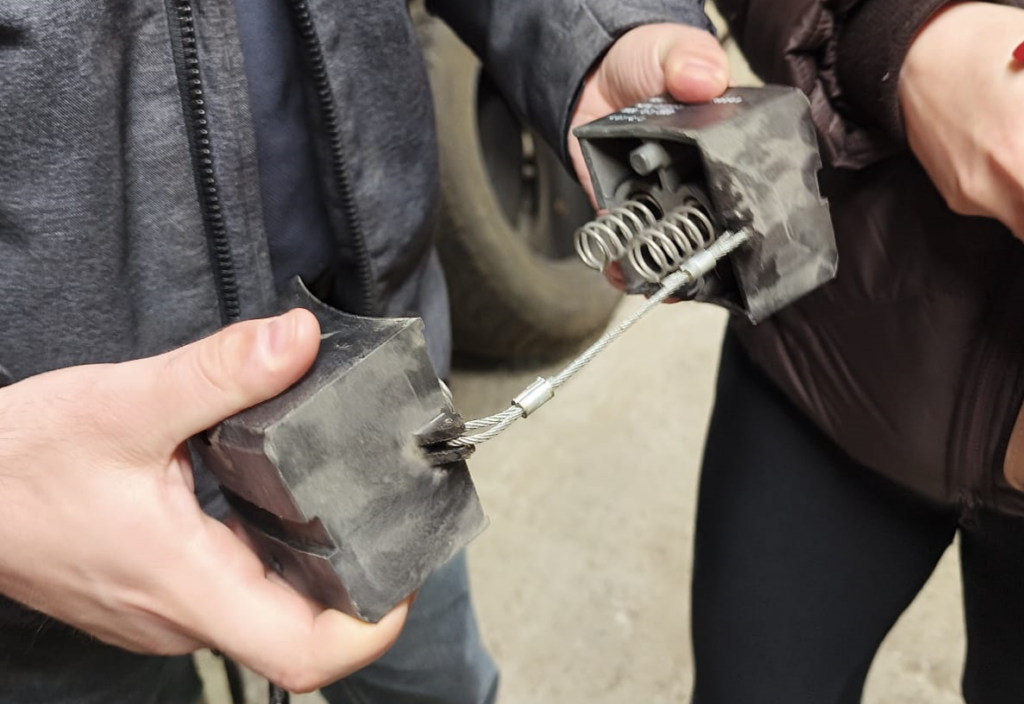
R: It lands and waits for equipment to drive by. There’s a camera here – see, the camera. There were three batteries here. And right here was the explosive charge. What saved the guys was that they came up behind it. And it was just sitting there. They just walked up, clipped it, took the charge, took the battery, and brought this to me as a gift.
I: Damn, so—
R: It was sitting right on the road. Ready to launch. It had legs too, it stands on its legs like that.
I: [Interpreting to English].
R: This is from a National Guard unit in Yampil. It was brought from Yampil.
R: And this, I see the guy was holding it. Ask him, does he know what this is? [no pic available]
R: Everyone asks about it. You don’t know?
H: Haven’t run into one of these in a long time.
R: No, he doesn’t know. It’s an American HIMARS. There’s a cap on the back of every rocket. It sits like this. And when it fires, the cap flies off and the rocket is launched.
R: A souvenir from Donbas. We were there personally during the launches, standing right nearby and just picking them up. Well, “nearby”, meaning a couple kilometers away. Then we drove up and took it for a memento, just to have it.
R: If the guys had come from the front instead of the back, then… In standby mode, it [the drone] can sit for 10 hours. Let me show you.
V: Thank you.
R: There was a grenade launcher charge screwed onto here.
V: [in English] Ah, yeah, I see.
R: From this kind of grenade launcher [points at one]. It goes in here. It’s from an RPG-7. [no pic available]
R: This one is an attack drone, but there are others just like it that drop things. Like, “pew.” We print those. We print a lot of them. I can’t show you where, unfortunately. For security reasons, we have over 30 3D printers. But we can’t go there, it’s too dangerous.
V: This is what my friend does. My friend makes parts like these for 3D printers.
R: [shows a small teardrop-shaped plastic container] Shrapnel goes in here, then it gets dropped, and “bang”! [shows a second part shaped like a dart tail] And this is called a “tail” [tailfin].
R: This is a souvenir.
I: He says if you’re interested, he can give you one as a souvenir. A little gift for you.
V: [in Ukrainian] My friend… she works… making these.
R: They manufacture these, yeah?
V: Yes, yes.
R: They 3D-print a lot of this in Ukraine. It’s because we don’t receive that many weapons from our partners, so we make what we can.
R: But this is a very powerful weapon, even if you might think it isn’t. When we started using FPV drones in ’23, for the first time, the Russians didn’t have them. A unit fighting near Bakhmut told me that just three FPVs could stop a company of advancing Wagners. That was at the beginning. They’d be attacking, three of these things would fall from the sky, and they’d run because they just didn’t understand what it was.
R: Wagner, yeah. In Bakhmut it was… by the way, I have a Wagner souvenir.
R: Well, not exactly a souvenir… it’s from there.
I: Do you know who “Wagner” are?
V: Yes, yes, Prigozhin intended to do something strange—
R: Here, look [shows a chest medal]. This was taken from the Wagners. A Russian souvenir, “Artel.” Artel is in the Far East, where they mine gold.
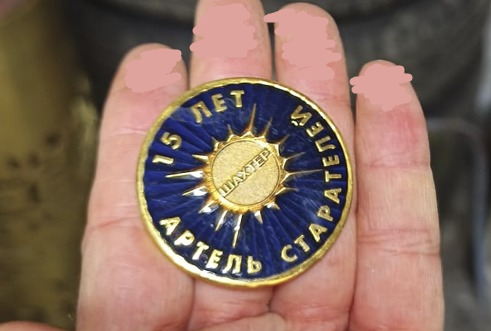
I: [Interpreting to English]. Is that a village there?
R: Yeah, it’s [the medal] not gold. It’s some kind of chest medal. Basically, they were mining gold, then decided it was better to come and kill Ukrainians because they could make more money that way.
[At this point an exchange took place which I felt deserved to be its own post]
R: [In Ukrainian] Come here, let me show you something. I have a friend, he’s a sniper. He’s from Liverpool.
V: [in English] Oh, his friend is a sniper from Liverpool?
I: Yeah.
R: [in Ukrainian] This is his sniper group, this flag here. His name is [Redacted].
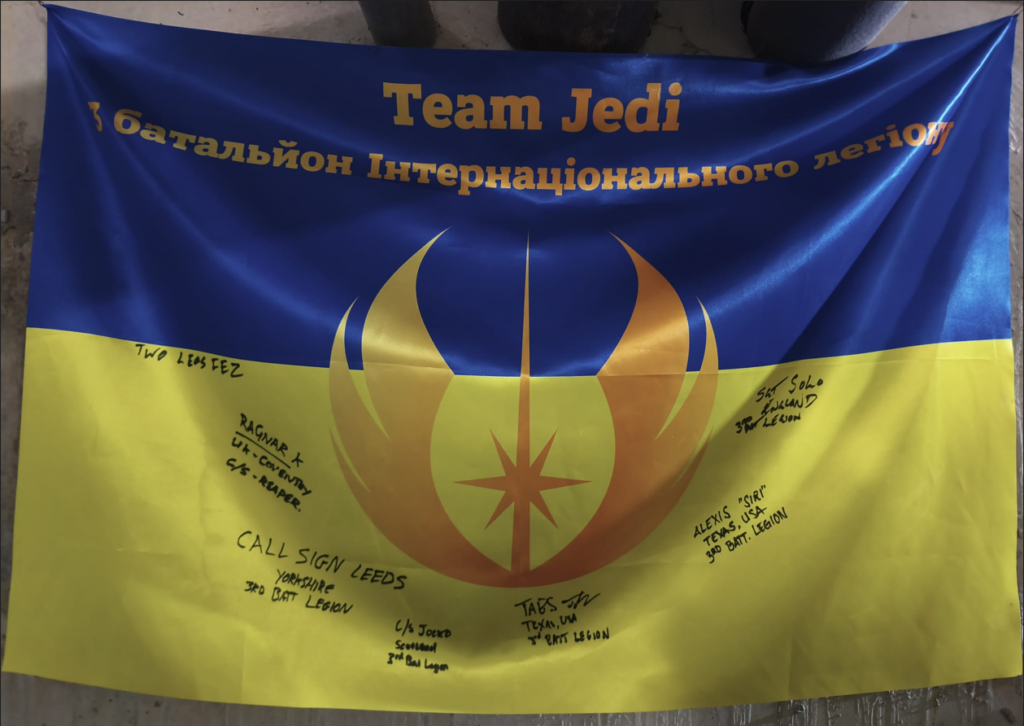
V: [in English] Oh, call sign Leeds!
R: [in Ukrainian] You can take pictures, this is their personal patch.
V: [in English] He’s from Leeds! Some of them are from Texas.
R: [in Ukrainian] I know this battalion personally.
I: And what are these diapers for?
R: Well, these are diapers, sometimes… [Vic with the recorder is still looking at the flag so audio is lost]
V: [in English] Someone’s from Coventry! Ah, this is the International Legion battalion.
H: I’m trying to see if I know any of these people. [reads the call signs written on the flag] No, none of them.
V: I know at least what cities they’re from.
H: I think I know [Redacted].
V: You want to talk to me about it? No, wait, does he want to talk to me? [laughs]
H: [laughs] No, I don’t think he’s still alive.
R: …there was an Englishman here, an American girl, [Redacted] from America. There was a Czech, one guy was Czech.
V: Czech Republic? [In Ukrainian]
R: Yeah, yeah, “Cheh Repyublec.” There are a lot of internationals there, mostly from Europe. Oh, there was a Canadian. Plenty of ‘em. He had a group specifically from Western Europe. Such powerful snipers they were.
V: Yes, it’s an International Legion battalion.
R: [in Ukrainian] Should I show their battalion [picture] now? I’ll show you their battalion right now.
I: [in English] He wants to show us their picture.
R: Here they are. [shows the picture] This is the first battalion of the International Legion. This is [Redacted]. Here he is. This is [Redacted], an Austrian, a close friend of mine, we’re still good friends. This is [Redacted], he died, a Canadian. He’s from Vancouver, Canada. I was in Vancouver last fall. Wanted to visit his grave, took this patch with me. Unfortunately, he was cremated and his ashes were scattered. I took the patch, and wanted to pay my respects to him.
R: And this patch belongs to that unit…
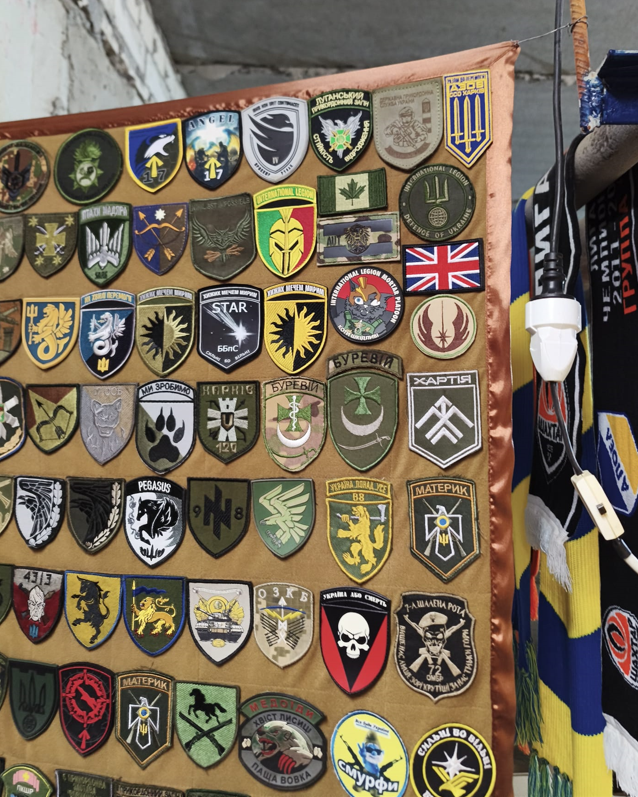
V: “The Jedi”.
R: Yeah, “The Jedi”, that’s them… Such interesting things we have here.
R: [brings a fragment of a Russian missile] This is a piece of missile/ Jne that hit Kharkiv tonight.

I: Is this from today?
R: No, not from today’s, but it’s exactly like that one, an X-101. This one was shot down near Pokrovsk by this unit, the 14th brigade. And this one was shot down near Kharkiv. It’s got a different number, see?
R: These are the rockets they shell us with – see, it has a tail (or a nose) like this? These are mementos for me from the air defense units.
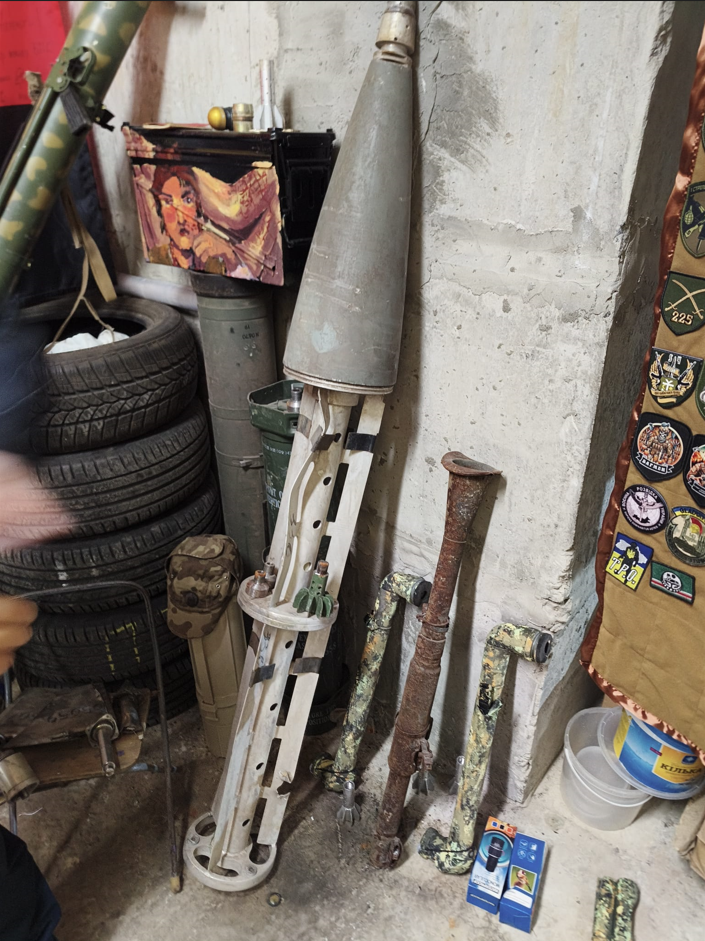
R: This is a cluster charge from an “Uragan.” Here they put cassettes. When it falls, they scatter and… it creates so many casualties.
R: This is a burnt Russian grenade launcher from near Kupyansk. I went and picked it up myself.
I: [Interpreting to English]. Dang, you’ve got so many artifacts.
R: This is very little of what’s left; there used to be so many, but now… Well, and here are my gifts that were given to me personally. I have a few awards from the state. There’s the famous K2 unit, if you know it – Kyryl Kyrylovych [commander’s name] – this patch is from them, they presented it to me.
I: [Interpreting to English].
R: I was nominated for an award. I have an award from the Commander of the Armed Forces, Zaluzhnyi.
I: I think I saw your photos with Zaluzhnyi on the internet.
R: No, not with Zaluzhnyi personally.
I: When you were getting the award, they were all over the internet, I think.
R: All my awards were in Kharkiv; I didn’t go anywhere. Maybe you saw something, they’re on display somewhere around the city. [shows the next patch] This is Phoenix. Phoenix, the Luhansk border guard detachment. I’m originally from the Luhansk region; I had to move here in 2014. This unit is the closest to me, these are my friends. One of the most powerful units when it comes to drones.

R: Hold on, I’ll show you their flag and patch… Here, this is the Luhansk border guard detachment. This is the Phoenix patch. And here’s their green flag.
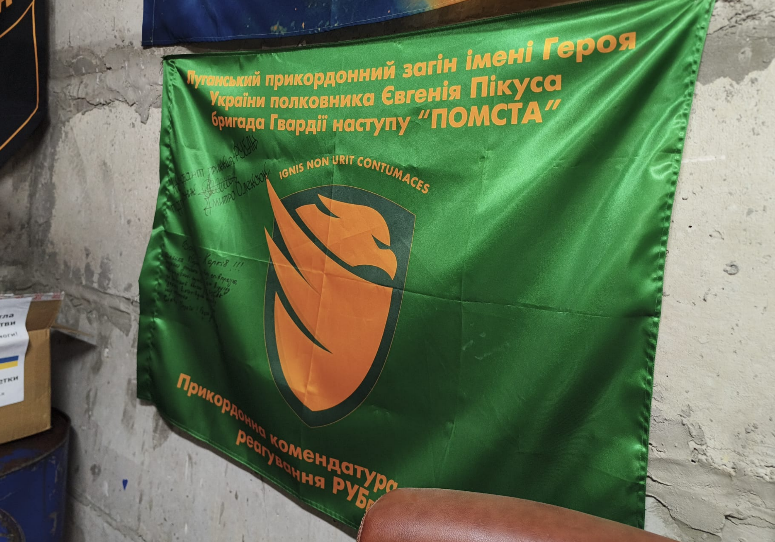
V: [in English] Their flag is green.
R: This is a personal gift from the battalion commander. I help them a lot, because… By the way, I really wanted to go and serve with them, but I just missed it by literally a month because I got caught in heavy shelling. Unfortunately, I won’t get in there anymore.
R: I just didn’t manage to mobilize with them in time.

R: Every flag has a whole separate story about the units. I’m often asked: “Why is your Ukrainian flag hanging the wrong way?” See, this one is upside down. But there’s a story there. It was the beginning of the war, a close friend of mine (he’s discharged now after many injuries) showed up all dirty and grimy. I say: “Be the first to sign a flag for me.” And the way he laid the flag down [upside down] is how he signed it. He was a sniper, Dima. One shot, one Moskal [russian], if you know what I mean. And that’s how it started. If you look, there’s no empty space left. Unfortunately, many aren’t alive anymore. This is my war history. This is everything I managed to get signed while I was traveling. I was traveling until March 2nd, 2024; on March 2nd, I got caught in the shelling.
V: [reads the inscription on one of the flags] “Russian warship, go fuck yourself.”
R: Yeah, yeah, well, that’s that.
R: Some people say… how do you say it in Ukrainian, “with reproach” [uses a russian word]? They say: “Don’t you know how to hang a flag?” When someone tries to tell me something like that, I say: “Don’t teach me how to love my motherland.”
I: Right, exactly.
R: Because I can teach anyone. I gave everything for this country. I’m from the Luhansk region; I lost everything there. I was a successful entrepreneur. And in 2014, I was “liberated,” as they say, from everything: they took my house, they took my business, they took all of it. In 2014, I moved here with my wife. We lived in a van for a week.
R: So I don’t need any motivation. When they came to Kharkiv, it just so happened that at the start of the full-scale, I was 52. I went to the enlistment office three times; they didn’t take me. They said: “We have plenty of young people who want to go fight”. I couldn’t just sit around. That [Redacted] van standing out there – that’s my van. I bought it with my own money, loaded it up, and went to the front line, and drove around for two years until the injury. There’s no other people’s money in any of this. This was all [purchased with] my own personal money.
R: That’s just a short detour from the topic. From the start of the war, it all began with this flag. I was in Bakhmut, in Avdiivka, Mar’inka – I was everywhere. The only place I didn’t go to was Kherson, ’cause it’s far from here. I drove all over Zaporizhzhia: Kostiantynivka, Bakhmut, Chasiv Yar, Druzhkivka. I drove through it all, but at some point something went wrong. I just missed it by a bit. A KAB hit [a Modified Long-Range Glide Bomb]; there was heavy shelling near Kupyansk. I was heading to this unit here. This unit is a special forces unit of the 43rd brigade. They were in the 416th battalion. I was bringing the boys an anti-drone gun. We had just managed to meet up, and then the KAB hit. A big one, 250 kilograms.
R: The boys died, I was the only one who survived. They died instantly. My arm was torn off, I got lots of wounds on my back, my legs, all over my body. Well, I’m still alive. They died in a heartbeat. And I just got lucky ’cause a military ambulance happened to be drivin’ by. They saw me, and managed to save me, save my life. Didn’t save the arm, though. I was carrying it, thinking they’d sew it back on. I was in a state of shock. I was holding it in my hand like this, carrying it, but there wasn’t much left to save.
R: By the way, March 2nd was exactly two years since it happened.
R: I’ll show you the boys who were with me, the ones who died. They were very powerful snipers, I had so much respect for them.
V: Which unit?
I: This one, the 43rd Brigade.
R: [in Ukrainian] Here, look, it was them. Kostia… [Note: shows a digital photo collage of fallen soldiers with birth and death dates]
I: And this one is so young… Ivakha.
R: Ivakha, well he… he wasn’t even forty. Kostia was my age, he was 54. He died, the commander. And this machine gunner, he was like this, a head taller than me. And Ivakha – he’s the commander, senior lieutenant, intelligence commander.
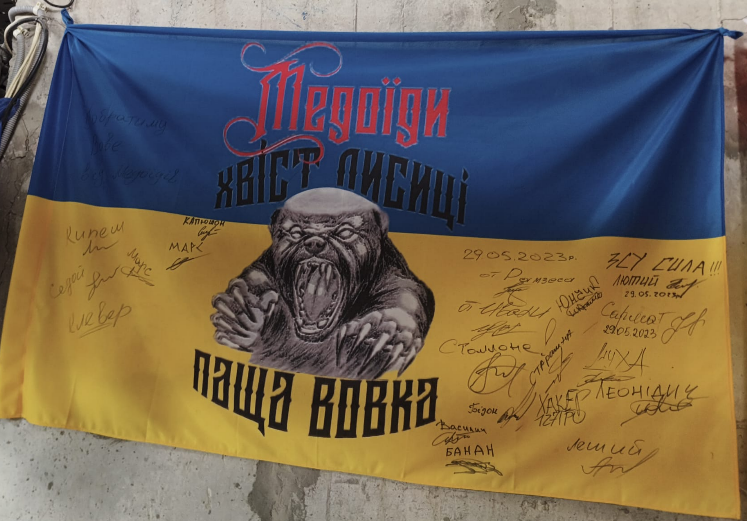
R: These are their signatures [points to flag]. This is a sore point for me. This is Ivakha, his signature. And this is Yunchyk. Yunchyk was the second commander. See, they’re right next to each other. All the others, thank God… Oh, and one more died… this one died. Everyone else is alive, fighting. And they were just here recently, I was giving ‘em generators.
R: It was a sniper group, a bunch of ’em. All were volunteers. They went through everything, too. And then, near Kupyansk – that was it.
R: This flag here, a volunteer kid gave it to me. He’s from Luhansk too, like a son to me. Then he volunteered to become a soldier, and now he’s fighting near Kherson. That was his gift.
R: The kid’s only 23. Just so you understand, not everyone’s in it for the money here. Young boys. He’s 23 now, but he’s already commanding a powerful group. We’re always talking, he’s constantly checking in. I actually managed to get him a car from the UK, a Nissan X-Trail. So he’s got his war horse now.
I: Thank God! [Interpreting to English].
R: He’s a comms commander… Look at this one, see, it’s a bit different. This flag’s a little dirty, see? And look here, pay attention, it’s all frayed. Know why? When a flag flies on a vehicle, it gets a bit torn up. This flag was one of the first to enter liberated Balakliia.
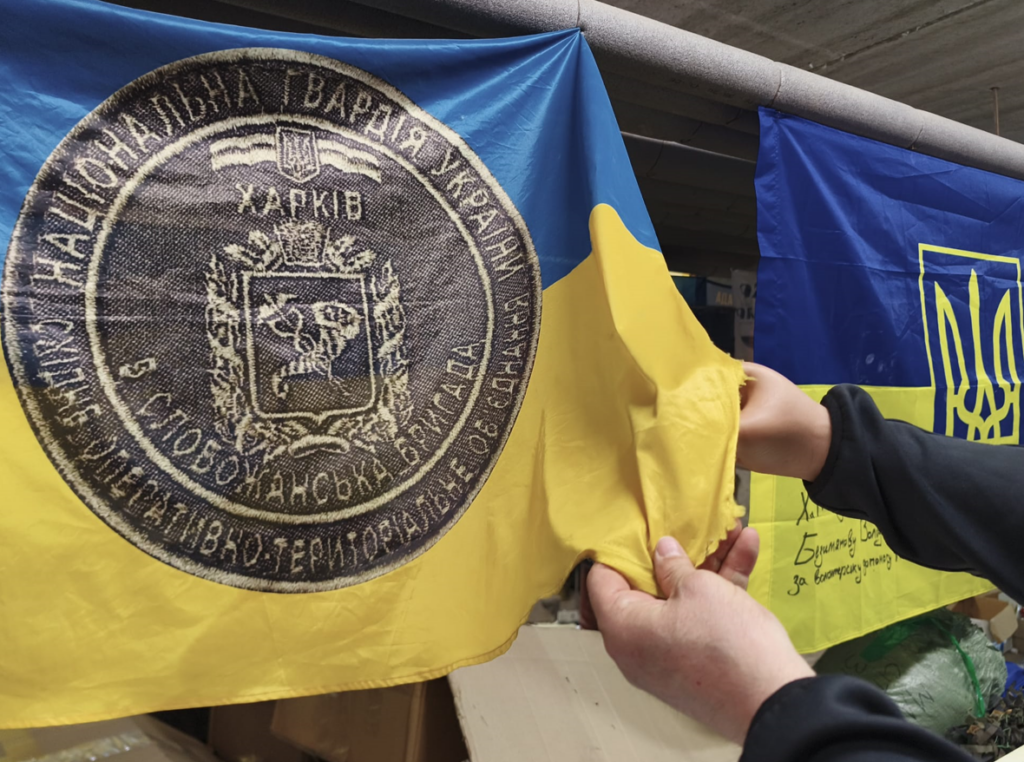
I: Seriously, Balakliia?! [Interpreting to English].
R: Fifth Slobozhanska Brigade, our Kharkiv boys. This flag went into Balakliia, and they gave it to me.
I: We interviewed them too, back in ’22 – the stories they told us, honestly, it made your hair stand on end.
R: I was there, in Balakliia. I went to Izium on the second day [after liberation].
I: Us too, actually! Maybe we crossed paths somewhere in Izium, we headed out on the second day as well.
R: Nah, I don’t remember. We went on the second day, but we took a sharp left down to the river and went across the river crossing.
I: So did we!
R: Well, maybe. Radkivka was all torn up, Pisko-Radkivska [a village near Izium], I drove through all that. Maybe we were driving right past each other, who knows. It’s just, I didn’t look like this back then. I was always in a vest, in a helmet. My vest is still laying somewhere here. I gave the helmet to the boys so it could do some good, but I can’t give up the vest – it’s a memory. This over here is a memory from them. All these flags are a sign of respect, the boys gave ’em to me.

R: The story of this flag – it’s not even a flag, I don’t know what to call it [no pic available]. A standard, I reckon? This kid was under occupation near Izium, lived with his parents. He walked all the way to Kharkiv on foot from the occupation.
I: Oh, my God!
R: On foot! He was 29 back then. Joined the National Guard, got wounded really badly in Bakhmut, right in the stomach. Survived, and now he’s a commander in Spartan. If you’ve heard, we have the “Lelekas” – large scout drones. He flies a Leleka. We became friends with his parents, our families are close now. Real principled guy, very well-read, a smart kid. We’re still tight with ’em. Now he’s got a unit called [Redacted], he’s a company commander there. That’s the story.
R: He started out as just a regular infantryman.
R: He volunteered to join the army, too. That’s just what I recall, ‘cause I could talk about any of these flags for hours… People say the police don’t fight. But I personally know a very militant police unit, who are real fighters – the “Liut” [Fury] special unit. The boys are fighting near [Redacted] right now. I know ’em personally. Real police officers.
H: [Redacted] serves there.
I: [in Ukrainian] A friend of ours serves there.
R: Well maybe, they might not be near [Redacted] right now, maybe near [Redacted]. It’s a big brigade, but I know ’em personally. Level-headed, decent folks. Good people… Plenty of different souvenirs here. This, if I remember right, is a Swedish grenade launcher. There’s all kinds of them in here. [No pic available]
R: This is from our old “Safari” assault regiment. They gave me a lot, but I’ve given most of it away. Just a short little story for you.
I: Alright, thank you.
R: Right now, unfortunately, there isn’t much of the stuff we usually help with.
V: [in English] Can you ask if these strings have any special purpose?
I: [in Ukrainian] These… follow me, I’ll show you. I forgot the name in Ukrainian. I know it in English, but it slipped my mind in Ukrainian. These…
R: Plastic? Souvenirs?
I: No, no, these…
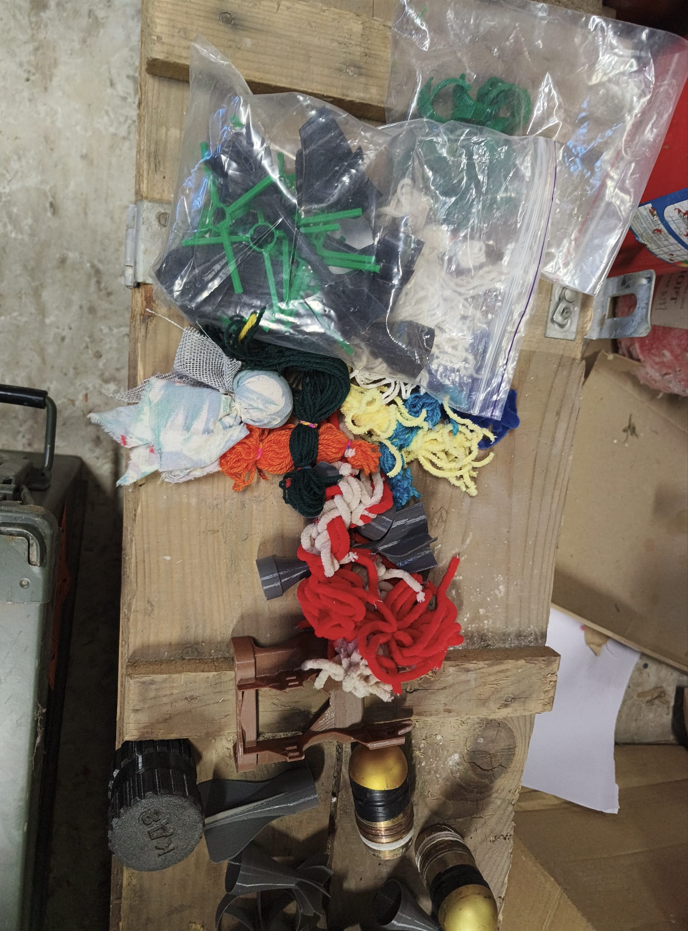
R: Oh, these are motankas [Note: Motanka doll is a traditional Ukrainian needle-free handmade talisman].
V: These are motankas?
[Respondent takes out a couple motanka dolls from the box]
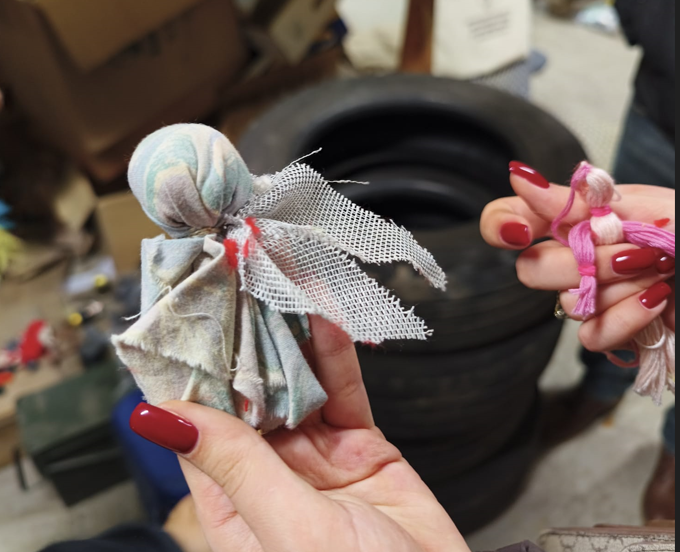
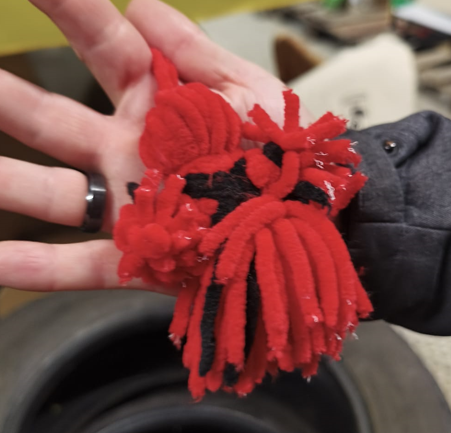
I: Oh, they really are motankas.
V: Can you ask who makes them?
I: [Interpreting to Ukrainian].
R: School kids give them to me, and we just hand ’em out to the soldiers. I can give you a black-and-bla… bla…
I: The red and black one?
R: Yeah. You can take it as a gift, no problem!
V: Thank you so much!
I: Thank you!
R: See, there’s different motanka dolls here. They’re a Ukrainian souvenir. Take one, go on! Give her one, let her take it, please!
I: [in English] Which one would you like?
V: I like this little one.
H: [in Ukrainian to Respondent] Thank you very much.
R: Sometimes schoolchildren, or even kids from the kindergartens, make home-baked treats, something interesting. And I just… The boys come by here, or I drive out sometimes to drop them off, and they take ’em. But yeah, it’s mostly empty in here now, ’cause with only one hand it’s tough. This warehouse used to be full. There were generators and everything the army needed. We never kept [stored] weapons here. There were sleeping bags, mats, just everything. I’d load it all into that van and head out, load it up and head out. I had friends who’d bring stuff here, and I’d just drive and drive. Oh, by the way, my vest’s still here, just lying around.
R: The thing is, helping the army isn’t just about weapons. There’s personal hygiene [items], and a bunch of other stuff; socks and all that. We used to stack it all in big boxes here ’cause we were loading for big units. Just constantly hauling it out.
I: Nothin’ ever sat around for long?
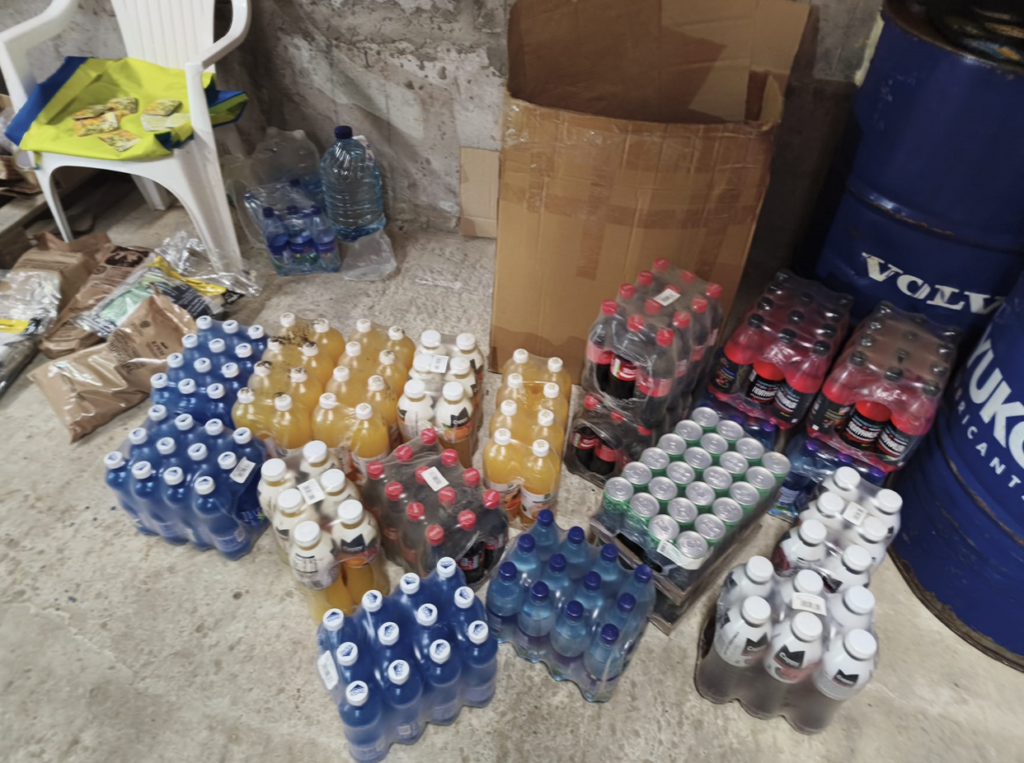
R: Nah. Now, sure, there’s leftovers sometimes. I work a bit differently now ’cause it’s hard to do all this with just one hand. The boys call: “We need this and that.” Thank God, folks [local volunteers] in Kharkiv help out. I’ll call them, they come here, pick me up, we go load up and head out. Just today we loaded a whole van with these beverages. The boys ask for them ’cause the government doesn’t provide that. They give ’em plain water. But everyone wants Pepsi or Coke. So we dropped some off here ’cause someone’ll be driving through tonight, they’ll definitely pick them up. Jerry cans, barrels, all that stuff. This whole cycle just keeps going for me constantly.
R: The Ukrainian businesses give all this for free, we don’t pay for it.
R: It’s the business owners themselves. We don’t force [compel] nobody. They call up: “We can help.”
I: Tell me, are these motanka dolls valued among the soldiers? How much do they believe in their powers?
R: Some folks are real believers. Historically, it’s just how it went – Western Ukraine is more religious, and Eastern Ukraine is less so. There’re historical reasons for that, I could talk about it for ages. I’m from Luhansk myself, so I get it. That’s just how it turned out. The ones from Western Ukraine – they’re more into it. They always have an icon and everything. People from Central and Eastern Ukraine are less religious, more atheists, if I’m being honest, but that doesn’t take away from their honour or dignity.
I: Not at all. There are historical reasons – the [Soviet] destruction of churches, the intimidation–
R: Me, I’m probably an atheist myself. Even though I have a cross from my mom, I’m still a person from the Soviet Union. Could talk about that for a long time too. Everyone’s got their own life story, and you can’t say this is right and that’s wrong.
I: But mostly, the non-believers, when you give it to them—
R: They take `em.
I: They take `em?
R: They take them, they don’t refuse. They send a lot of icons too. I’ll show you. Here, take this, just as a memento [hands over a prayer written on a little laminated piece of paper]. They print a lot of these, send ’em over. It’s a prayer. The boys always have them – some carry it with ’em, some just keep it in the dugout. We get sent a lot of [kid] drawings too.
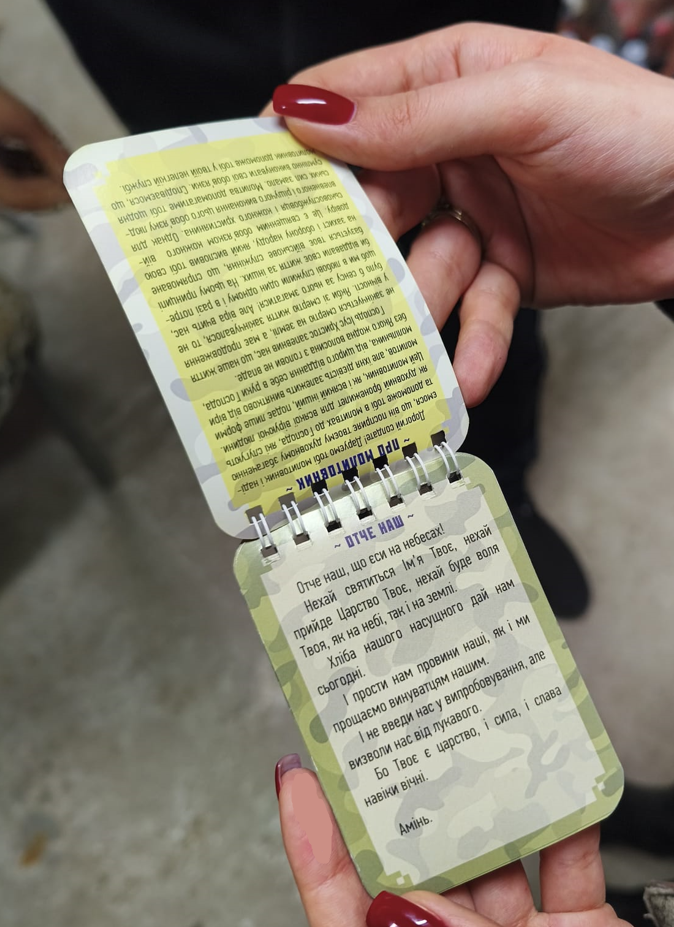
I: Is this important for the soldiers? What does it mean to them? What do they say about it?
R: As a military volunteer, I’m 100% sure that for them, it’s not even about having the thing. The main thing is they know they haven’t been forgotten. ‘Cause everything out there at the zero line – it’s a different world. I’ve spent a lot of time on the front lines, a lot, and I know what I’m talking about. Life is different there, the relationships between people are different. Totally. It doesn’t mean they’re better here or worse there. They’re just different. Absolutely different. So, it’s important to the soldiers that they’re remembered. That’s for real. Every time I’d show up, climb down into their dugouts – especially in Bakhmut, that was real tough – everyone’s sitting there, and I pull stuff out: “The kids sent this for you.” And, right away, there’s a feeling of some sort of respect… well, not respect, but an understanding that they haven’t been forgotten.
I: I see, so they really value them.
R: Look, see, kids make these [shows a little handmade charm].
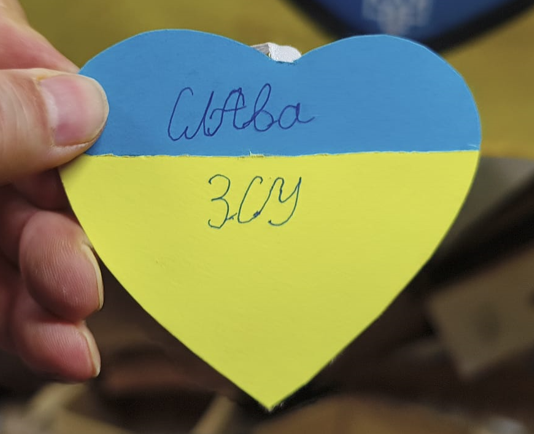
V: [reads Ukrainian inscription] “Glory to the ZSU.”
I: Children make these too.
R: All this is done by kids. I’ll give you a little souvenir. This is a cool little thing. It’s embroidery, see, they knit it or something. Here’s a little present for you. [hands over a little blue and yellow knitted heart]
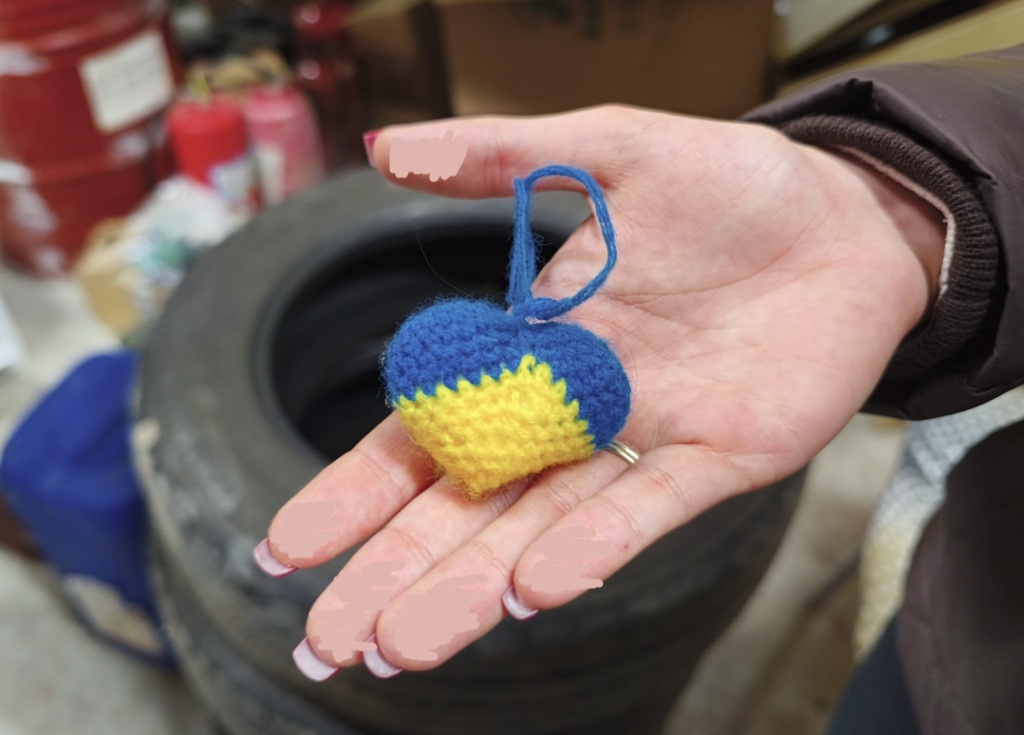
I: Thank you! You’ve already given us so much. Maybe it’s better to give these to the soldiers?
R: Our soldiers are taken care of, believe me. Thank God, they’re doing alright. I always say, I’m the link between the civilians and the army. ‘Cause there’s so many people who want to help but don’t know how.
I: Yes, that’s true. [Interpreting to English].
R: Sometimes foreigners come by. Not long ago I had some from France, they brought Mivina [instant noodles].
I: They brought Mivina all the way from France?
R: Yeah, they were in France and said, here, give your boys some Mivina. There was a whole mountain of different kinds. People just bring stuff and say, give ’em this, give ’em that. This here, by the way, if you’ve seen ’em, these are Ukrainian army MREs, all different kinds. This one’s the best.
R: This is the best MRE. Sweden, I think. The best one there is. They give ’em to the special units. There’s Polish here too, and… these are imports, not Ukrainian. I give ’em out if needed, and I can let you try one too.
I: No need, those should go to the soldiers.
R: These aren’t for the soldiers, they’re for souvenirs for people.
I: Souvenirs for people? In that case, okay.
R: You know, for the ones who donate, for the ones who help. That’s just how it works here.
H: [in English] In my experience, the Italians had the best MREs because they always had a little 250ml bottle of wine.
R: Ah, well, that’s Italy. I used to do a lot of mountain skiing. Italians are a whole different breed.
H: We were always trading ours [American ones] for theirs.
H: After two weeks, our commanders realized why we liked the Italian MREs so much and banned them. [laughs]
R: Speaking of Italy, actually. We have the International Legion and there were two Italians there. Man, they’re just too emotional. They’re all like “wow!”
[Everyone laughs].
Leave a Reply